























How to Build an AI Governance Framework: A Step-by-Step Guide
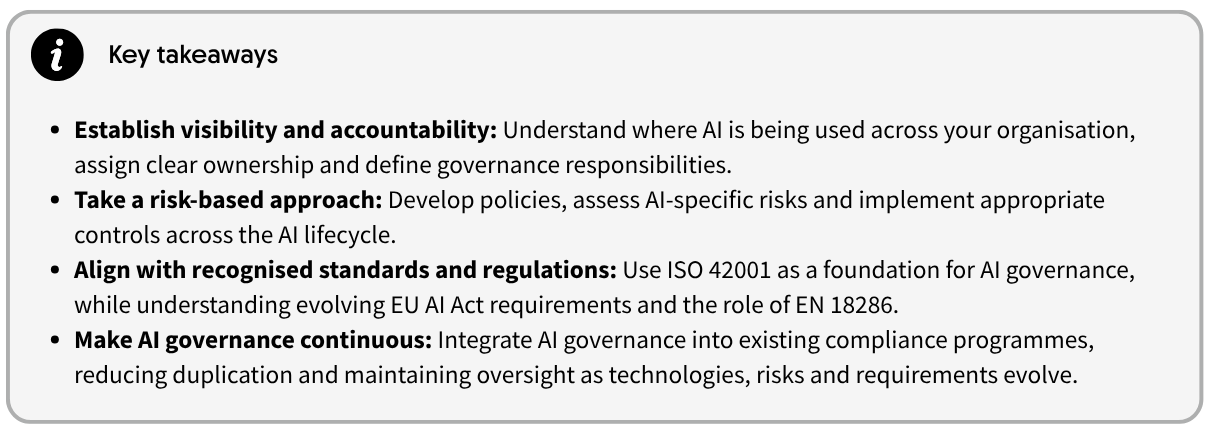
Discover how to build a robust AI Governance Framework that brings together the policies, processes, people and controls needed to manage AI responsibly across your organisation. This practical guide breaks down the key steps to establishing accountability, managing AI risks, implementing effective controls and aligning with ISO/IEC 42001 and evolving EU AI Act requirements, helping you build a connected, sustainable approach to AI governance and continuous compliance.

How to Build an AI Governance Framework: A Step-by-Step Guide
AI adoption is accelerating. But for many organisations, the governance needed to manage it hasn't kept pace.
From generative AI tools used by employees to AI-powered decision-making embedded within business operations, organisations are introducing new technologies without always having a consistent approach to managing the risks, responsibilities and controls involved.
The challenge isn't simply knowing where AI is being used. It's understanding who is accountable, what risks it introduces and whether the organisation can demonstrate that AI is being used responsibly.
That's where an AI Governance Framework comes in.
A well-structured framework connects the policies, processes, people and controls needed to manage AI across its lifecycle. It establishes accountability, supports responsible innovation and helps organisations respond as technologies, risks and regulatory expectations evolve.
In this guide, we'll explore how to build an AI Governance Framework, where ISO 42001 fits and what recent developments under the EU AIAct mean for organisations establishing AI governance.
What is an AI Governance Framework?
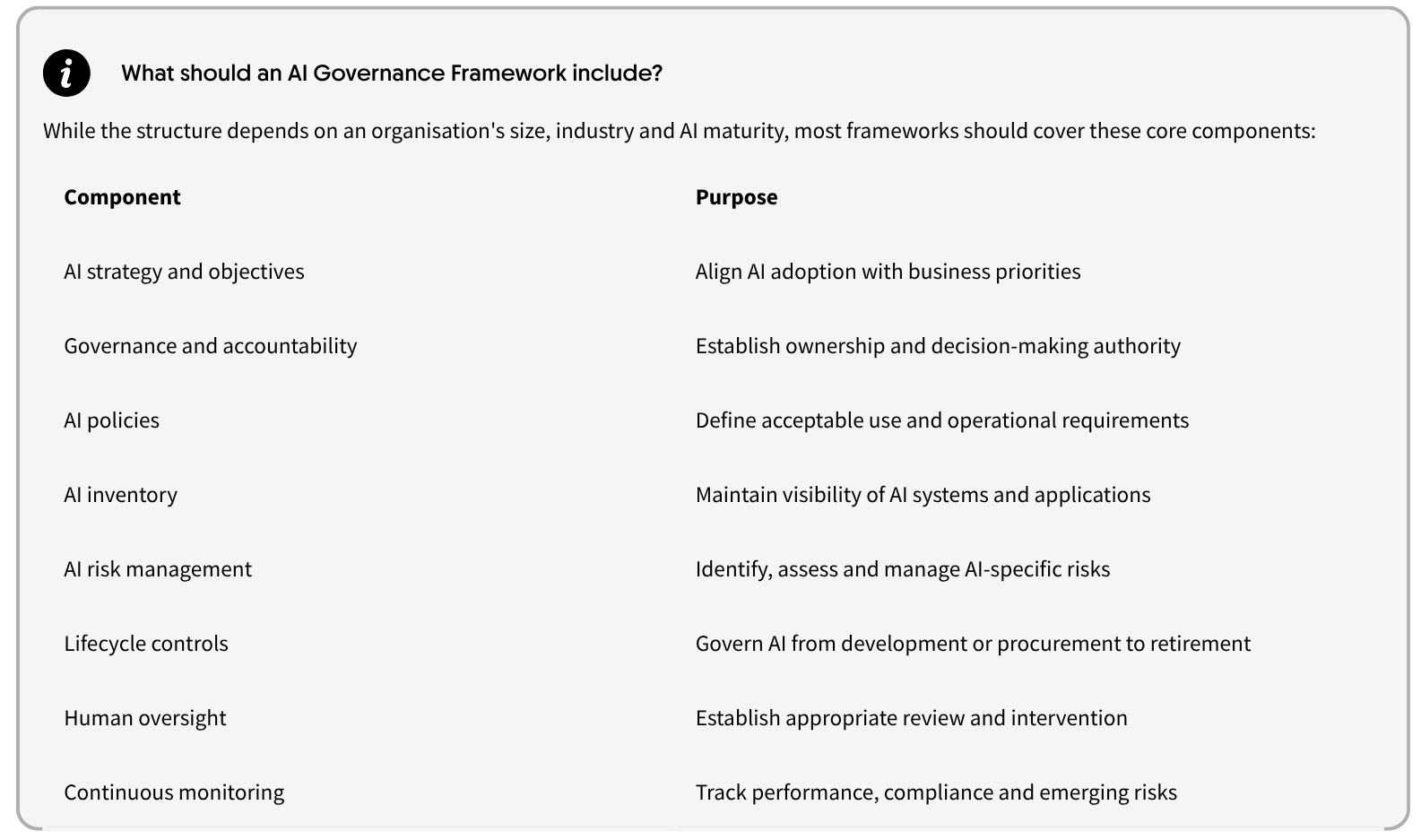
An AI Governance Framework is a structured approach to managing how artificial intelligence is developed, deployed, used andmonitored within an organisation.
It defines the policies, responsibilities, processes and controls needed to ensure AI is used responsibly, securely and in line with business objectives and applicable regulatory requirements.
Rather than treating AI governance as a standalone technical exercise, an effective framework connects AI-related decisions to wider risk management, information security, compliance and operational processes.
Why Do Organisations Need an AI Governance Framework?
As AI becomes embedded in everyday operations, organisations face a growing challenge: maintaining control over technologies that can evolve rapidly, process sensitive information and influence business-critical decisions.
Without a defined framework, AI adoption can become fragmented. Different departments may introduce tools independently, risk assessments may be inconsistent and ownership can become unclear.
An effective AI Governance Framework helps organisations improve visibility, manage AI-specific risks, establish accountability and demonstrate responsible AI practices to customers, regulators and other stakeholders.
Crucially, governance shouldn't slow innovation down. The right framework gives organisations the confidence to adopt AI while understanding the safeguards needed to manage it responsibly.
How to Build an AI Governance Framework: 7 Practical Steps
This doesn't necessarily mean starting from scratch.
Many organisations already have established processes for information security, risk management, data protection and internal auditing.
The challenge is identifying where those processes can support AI governance, where additional controls are needed and how to bring everything together into one manageable programme.
Step 1: Identify where AI is being used
Before establishing governance controls, you need a clear understanding of your organisation's AI landscape.
This includes AI systems developed internally, capabilities embedded within existing software and third-party AI tools used by employees or suppliers.
Start by creating an inventory that documents:
- Each AI system's purpose and intended use
- The department and individual responsible
- Whether it is internally developed or supplied by a third party
- The data is accesses, processes or generates
- Its potential impact on customers, employees or other stakeholders
- Any existing security, privacy or compliance controls
This exercise can reveal AI use cases operating outside of formal IT or procurement processes.

Step 2: Define AI Governance Roles and Responsibilities
AI governance cannot sit solely with IT, security or compliance.
AI systems influence decisions across HR, finance, operations, customer service and product development. Effective governance therefore requires cross-functional accountability.
Establish who is responsible for setting AI policies, approving new use cases, conducting risk assessments, maintaining controls and escalating incidents.
Depending on your organisation's size, these responsibilities may sit with an AI governance committee, an existing risk committee or designated individuals across business functions.

Step 3: Establish Your AI Governance Policies
Once responsibilities are defined, establish the policies that guide how AI is introduced and used.
Your AI governance policy should reflect your organisation's objectives, risk appetite and the types of AI systems it operates.
Supporting policies may cover:
- Acceptable AI use
- AI procurement and supplier assessments
- Data protection and information handling
- Transparency and explainability
- Human oversight and decision making
- Testing, monitoring and incident management
Policies should be practical enough for employees and system owners to follow.
A policy that exists only as a document offers limited value if teams don't understand their responsibilities or how requirements apply to their work.

Step 4: Conduct AI Risk and Impact Assessments
Not every AI system introduces the same level of risk.
An internal productivity tool may have a very different risk profile from an AI system used to influence recruitment, financial eligibility or healthcare decisions.
Your framework should establish a consistent approach to assessing these differences.
Consider risks relating to:
- Data privacy and security: Exposure of sensitiveinformation or new vulnerabilities.
- Bias and fairness: Potentially unfair ordiscriminatory outcomes.
- Transparency: Whether decisions and system usecan be explained.
- Accuracy and reliability: Consequences ofincorrect or unpredictable outputs.
- Human oversight: Where intervention or approvalis required.
- Third-party dependencies: Risks introduced byexternal providers and models.
- Regulatory obligations: Requirements applicableto each system and jurisdiction.
Assessments should inform decisions about whether systems can be introduced, which controls are needed and how risks will be monitored.

Step 5: Implement Controls Across the AI Lifecycle
Identifying risks is only part of the process. Organisations must also establish the controls needed to manage them.
These should apply throughout the AI lifecycle, from procurement and development through testing, deployment, operation and retirement.
Depending on the system, controls may include approval processes, data access restrictions, testing for bias and reliability, human review, supplier due diligence, change management and incident reporting.
Controls should be proportionate to the risks involved and supported by clear ownership.
For example, an AI system supporting an internal administrative process may require different safeguards from one influencing decisions that directly affect individuals.

Step 6: Align with ISO 42001 and Regulatory Requirements
ISO/IEC 42001 provides an internationally recognised foundation for AI governance, establishing requirements for managing AI-related risks, responsibilities, policies and controls.
However, organisations must also consider how these standards align with evolving regulatory requirements.
ISO 42001, EN 18286 and the EU AI Act: What's Changed?
On 14 October 2026, EN 18286:2026 was cited in the Official Journal of the European Union (OJEU), marking an important development in EU AI Act compliance.
The standard provides a harmonised route to demonstrating conformity with specified quality management requirements under Article 17 of the EU AI Act, particularly for providers of high-risk AI systems.
Here's how the three fit together:
- ISO 42001: Provides a broader framework for responsible AI governance, risk management and continual improvement.
- EN 18286: Supports conformity with specified EU AI Act quality management requirements.
- EU AI Act: Establishes the legal obligations applicable to AI systems and organisations within its scope.
These are complementary, but not interchangeable. ISO 42001 certification does not automatically demonstrate EU AI Act compliance.
Organisations should identify their applicable requirements, reuse existing governance processes where possible and address any remaining gaps.

Step 7: Monitor, Review and Improve
AI governance doesn't end once policies are approved and controls are implemented.
AI systems evolve. Their use cases change, suppliers update their models and emerging risks can alter an organisation's exposure.
Establish processes for reviewing AI inventories, reassessing risks, monitoring controls, tracking incidents, conducting internal audits and updating policies.
This is where organisations need to move beyond periodic compliance exercises towards continuous governance.
Rather than retrospectively collecting evidence ahead of an assessment, governance activities should produce an ongoing record of decisions, controls and actions as part of everyday operations.

Quick-Fire Checklist
Use this practical checklist to assess where yourorganisation stands:
- Identify and document AI systems and use cases
- Assign governance roles and responsibilities
- Establish and communicate AI policies
- Conduct AI risk and impact assessments
- Implement proportionate lifecycle controls
- Align governance processes with ISO 42001 andapplicable regulatory requirements
- Establish ongoing monitoring, review andimprovement.
Integrating AI Governance with Existing Compliance Programmes
AI governance doesn't have to mean starting from scratch. Organisations already managing ISO 27001, ISO 9001 or other frameworks can build on existing policies, risk assessments, supplier management and audit processes.
While ISO 42001 introduces AI-specific requirements, reusing relevant controls and evidence helps reduce duplication and creates a more connected approach to compliance.
Common Mistakes to Avoid
- Treating governance as an IT-only responsibility: AI requires accountability across the whole business.
- Creating policies without ownership: Clear responsibilities are essential for effective implementation.
- Duplicating existing processes: Build on established compliance activities rather than creating separate programmes.
- Treating governance as a one-off exercise: AI risks, controls and requirements need continuous review.
How Hicomply Supports AI Governance and ISO 42001
Building an AI Governance Framework is one challenge. Maintaining it as AI adoption grows is another.
Hicomply's whole-business ISMS platform brings policies, risks, controls, evidence and responsibilities together in one place, helping organisations:
- Reduce duplication: Map and reuse controls and evidence across ISO 42001, ISO 27001 and other frameworks.
- Maintain oversight: Track responsibilities, monitor controls and identify gaps continuously.
- Stay audit-ready: Keep evidence connected, relevant and up to date throughout the year.
- Access expert support: Benefit from unlimited support from our in-house compliance specialists throughout the certification lifecycle.
One connected programme. Less manual effort. Greater confidence in your AI governance.
FAQs
What is an AI Governance Framework?
An AI Governance Framework is a structured set of policies,processes, responsibilities and controls used to manage how artificialintelligence is developed, deployed and used within an organisation. It helpsestablish accountability, manage risks and support responsible AI adoption.
How do you create an AI Governance Framework?
Start by identifying AI systems, establishing governanceresponsibilities, developing policies and assessing risks. Then implementappropriate controls, align processes with recognised standards such as ISO42001 and establish ongoing monitoring and improvement.
Is ISO 42001 an AI Governance Framework?
ISO 42001 is an international standard for AI managementsystems. It provides requirements that organisations can use as the foundationfor an AI Governance Framework, supporting structured risk management,accountability, operational controls and continual improvement.
How do ISO 42001 and EN 18286 relate to the EU AI Act?
ISO 42001 provides an international management-systemframework for responsible AI governance.
EN 18286:2026 addresses quality management requirementsunder the EU AI Act. Following its citation in the OJEU in October 2026,conformity with the standard provides a presumption of conformity with the EUAI Act requirements it covers.
Organisations should assess which requirements apply and howexisting governance processes can support them.
Can AI governance be integrated with ISO 27001?
Yes. Organisations can reuse relevant processes, includingrisk management, policy governance, internal auditing and corrective actions.However, AI-specific risks and requirements must also be addressed. ISO 42001complements ISO 27001 rather than replacing it.
Ready to Take Control of Your Privacy Compliance?
See how Hicomply can accelerate your path to CAF compliance in a 15-minute demo.