




































Why expanding your compliance programme shouldn't mean multiplying your workload.
Achieving your first certification is a significant milestone. It opens doors to new commercial opportunities, strengthens customer confidence and establishes foundations for good governance across your business.
But it's rarely the end of the journey.
As organisations grow, so do the expectations placed upon them. New customer requirements, expansion into international markets, evolving regulations and the adoption of new technologies all influence the direction of a compliance programme.
Before long, one framework becomes two. Two become three. And what was once a manageable compliance programme becomes an increasingly complex operational responsibility.
The question is, why should expanding your compliance programme mean repeating so much of the work you've already done?
From one certification to the next.
How this challenge manifests will look different depending on the size, maturity and ambitions of your business.
1. The scaling business: Unlocking new markets
ISO 27001 to SOC 2
Consider a growing technology business that has just achieved ISO 27001 certification.
It's invested considerable time in establishing its ISMS – developing policies, documenting processes, assessing risks and gathering evidence.
Then, a commercial opportunity arises in the US. A prospective customer requires SOC 2 assurance.
Much of the groundwork is already there. Yet, without an effective way to identify and manage the overlap between the two frameworks, the team finds itself revisiting policies, gathering the same evidence and maintaining separate sets of documentation.
2. The smaller business: Competing for bigger opportunities
Cyber Essentials Plus to ISO 27001.
Now take a smaller IT services business that has achieved Cyber Essentials Plus. As it begins competing for larger contracts, ISO 27001 becomes a commercial priority. Its existing security practices provide a valuable starting point, but how effectively can it carry that work forward?
For these organisations, compliance often sits alongside someone's primary role. Every hour spent duplicating work is an hour taken away from growing the business, supporting customers or improving its security posture.
3. The enterprise: Keeping pace with evolving governance demands
ISO 42001 and beyond.
Now consider an enterprise.
It already manages multiple ISO standards across different business divisions, with varying levels of maturity, different stakeholders and separate audit schedules.
As AI adoption accelerates across the organisation, the board identifies ISO 42001 as its next priority.
The challenge isn't necessarily establishing governance from scratch. It's understanding what's already in place, where existing requirements overlap, where genuine gaps exist and how to maintain oversight across an increasingly complex business.
Different organisations, different challenges. But ultimately, the same underlying problem.
The hidden cost of multi-framework compliance
The drain isn't simply the work involved in achieving another certification. It's the cumulative workload of maintaining each framework thereafter.
A policy is updated. Which frameworks does that change affect?
A new risk is identified. Where does it need to be reflected?
A piece of evidence is replaced. Is it still relevant to every control it previously supported?
When frameworks are managed in isolation, even relatively straightforward changes can create a chain of manual tasks across multiple programmes.
Over time, this introduces more than operational inefficiency. It creates the potential for inconsistencies, outdated evidence, duplicated responsibilities and fragmented visibility of an organisation's overall compliance position.
And the more frameworks a business introduces, the harder that becomes to manage.
Compliance requirements will continue to evolve. The way we manage them needs to evolve too.
One compliance programme. Not multiple versions of it.
One of the fundamental principles behind how we've built Hicomply is that compliance should be managed around the business, not in isolation around individual frameworks.
Your business doesn't have three entirely different approaches to information security because it follows three different standards. So why should your compliance programme operate that way?
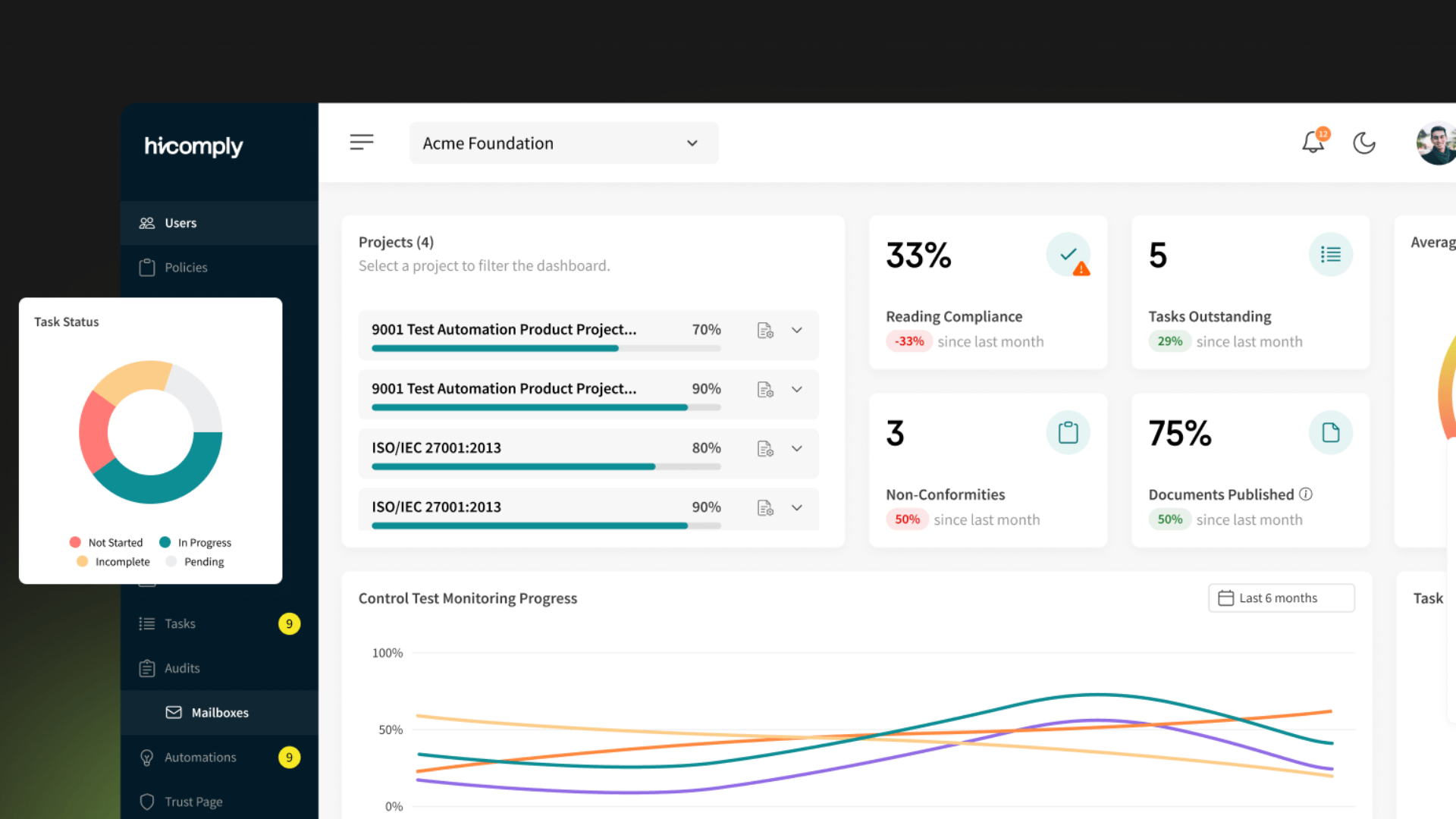
By bringing policies, risks, assets, tasks, controls and evidence into one connected workspace, organisations can build on the foundations they've already established.
Cross-framework mapping is central to this.
Take an organisation that's already ISO 27001 certified and is now looking towards ISO 42001. There are shared management system requirements across both standards. Rather than working through these independently, organisations can leverage relevant existing work and direct their resources towards the additional AI-specific requirements.
For a smaller business, that could make the difference between pursuing another certification now or putting it on hold because of constraints.
For an enterprise, it means greater consistency across business divisions, clearer oversight and a more scalable approach to governance.
The focus should be on what's new, not what's already been done.
Using technology to reduce the drain
Cross-framework mapping is only part of the solution.There's also a significant opportunity to use technology more intelligently to reduce the manual workload associated with maintaining multiple frameworks.
Think about the volume of information your business generates every day. Training records, supplier assessments, IT service tickets and security reports. Much of this could demonstrate the effectiveness of controls across multiple frameworks, yet identifying, mapping and maintaining it remains a considerable time drain.
This is where AI can add genuine value. Through AI Evidence Discovery, relevant evidence can be continuously identified from connected systems, with intelligent mapping suggestions helping teams maximise its use across frameworks and keep their evidence bank up to date.
The same principle applies to cloud security. Through Cloud Control Monitoring, existing cloud security findings can be connected to wider compliance requirements, without teams having to interpret and translate those findings for each framework independently.
Both capabilities, which we explore in our latest Product Update, are underpinned by the same thinking.
How can we make better use of the information businesses already have, reduce the duplication of effort and give people more time to focus on the work that genuinely strengthens their compliance posture?
Using AI for good. But where do we draw the line?
One of the questions I find particularly interesting isn't how much of compliance we can automate, but how much we should.
There's a fundamental difference between automating a process and automating accountability.
AI can find a document that appears to satisfy requirements across three frameworks. But does that document accurately reflect how the business operates? Is it sufficient? Does it demonstrate that the control is effective in practice?
Those are questions that require human judgement.
The same applies to drafting policies, assessing risks and determining appropriate actions.
My colleague Eve explores where automation meets oversight in compliance. The opportunity lies in giving people better information and more capacity to exercise their judgement, rather than transferring responsibility to technology.
It's a principle that will continue to guide the next chapter of AI development at Hicomply.
We're working towards making compliance more intuitive and proactive, helping organisations understand their requirements, identify priorities and navigate their next steps with greater confidence.
Because using AI for good in compliance should mean strengthening governance, not simply accelerating the completion of tasks.
Your compliance programme should enable growth, not drain resources
Whether you're a 20-person technology business pursuing your second certification or a global enterprise harmonising requirements across multiple divisions, compliance should support the direction your business is moving in.
Every new framework should build on the foundations you’ve already established, wherever possible.
And every advancement in technology should give your people more time to focus on what genuinely matters: strengthening resilience, managing risk and making better-informed decisions.
That's what we're building at Hicomply.
Intelligent technology that reduces complexity, a connected workspace that grows with your business and people who remain at the centre of good governance.
More frameworks shouldn't mean more of the same work.