



























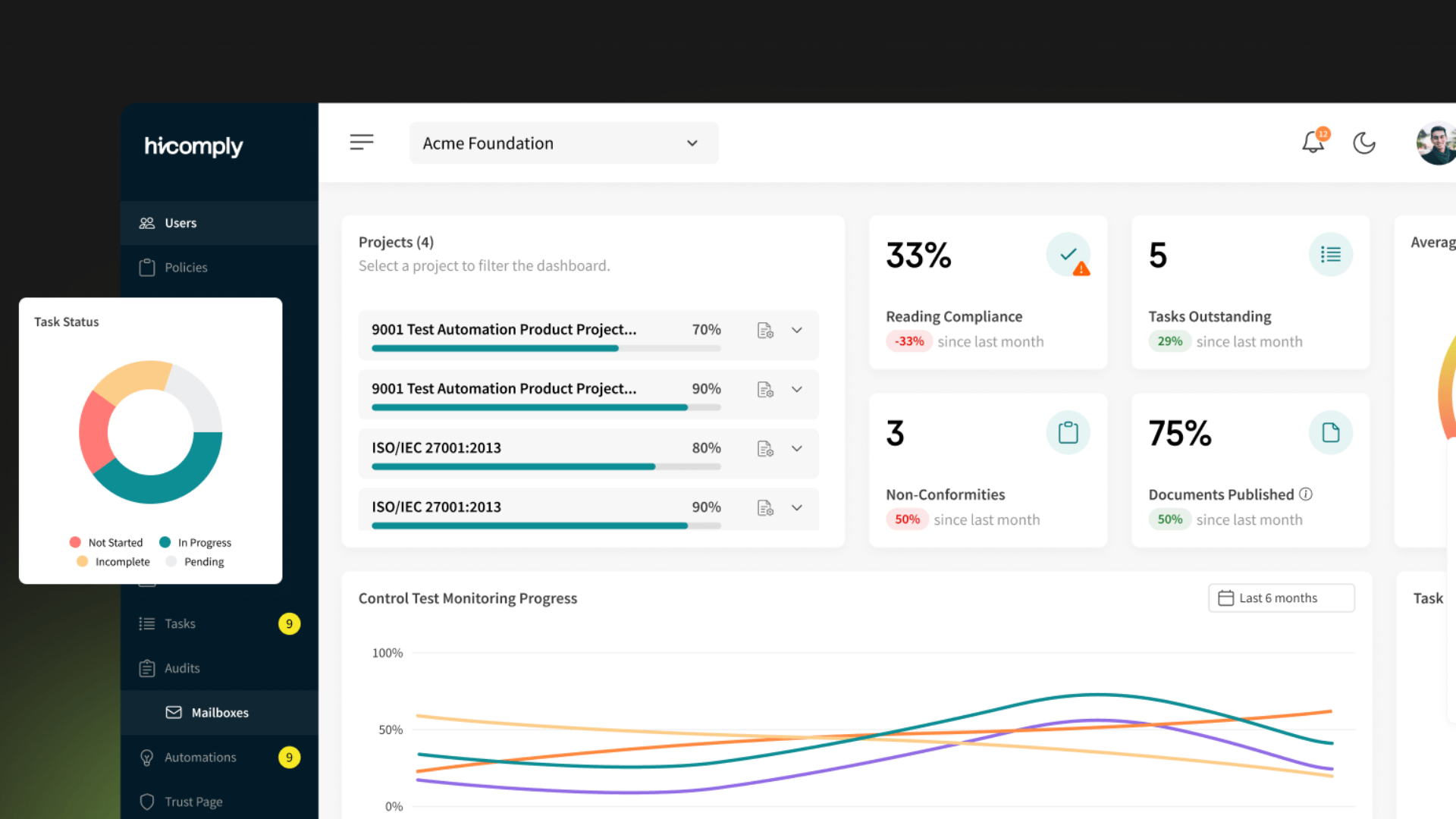




What to look for in a compliance platform that's right for your organisation
Choosing the right compliance management software means finding a platform that does more than help your business achieve certification.
The right solution should connect everything all together, reduce manual admin and help your organisation maintain audit readiness as its requirements evolve.
But with different platforms offering everything from automated evidence collection to wider governance and risk management, how do you know which is right for your business?
The best compliance software supports your whole business, expands with the frameworks you need and helps you manage compliance continuously, not just when an audit approaches.
This guide explores the different types of compliance software, six capabilities worth prioritising and the questions to ask when evaluating providers as you plan ahead for 2027.
What is compliance management software?
Compliance management software helps organisations manage the policies, risks, controls, evidence and activities needed to meet regulatory requirements, industry standards and certification frameworks.
Rather than relying on disconnected spreadsheets, shared drives and individual tools, a compliance platform brings these activities into one system.
Core capabilities typically include:
- Policy management: Create, review, approve and distribute policies, with visibility into employee acknowledgement
- Risk management: Identify, assess and manage risks, linking them to relevant controls and treatment plans
- Control and evidence management: Track control implementation, maintain evidence and identify gaps
- Audit management: Prepare for audits, manage findings and track corrective actions
- Multi-framework compliance: Manage standards such as ISO 27001, SOC 2, ISO 42001 and more, reusing relevant controls and evidence
- Compliance automation: Reduce the repetitive tasks and lengthy admin through smart integrations, automated checks and workflows
The real value comes from connecting these processes, helping teams maintain oversight and respond to changes without duplicating work.
Why is continuous compliance important?
Continuous compliance means maintaining oversight of compliance requirements throughout the year, rather than treating certification or annual audits as the primary point of activity.
Achieving certification is an important milestone. But it doesn't mean the work is finished.
Between audits, businesses change. Employees join and leave, suppliers are introduced, technology evolves and new risks emerge.
Without ongoing oversight, policies become outdated, evidence loses relevance and controls may no longer reflect how the organisation operates.
This creates a familiar cycle: preparing intensively for an audit > achieving certification > revisiting the same work when the next assessment approaches.
Continuous compliance helps organisations move beyond that cycle.
For example, ISO 27001 requires organisations to maintain and continually improve their information security management system (ISMS). Similarly, SOC 2 Type II examinations assess how controls operate over a defined period, rather than at a single point in time.
The right software helps teams identify gaps, maintain current evidence, track responsibilities and demonstrate compliance to auditors and customers.
Continuous audit readiness isn't about preparing for an audit every day. It's about maintaining the visibility and processes needed so preparation doesn't start from scratch.
What are the different types of compliance software?
Not all compliance platforms are designed to solve the same challenges.
Some focus on technical security controls and automated evidence collection. Others provide broader governance, risk and compliance capabilities or support an organisation's entire ISMS.
These categories overlap, and many modern platforms combine capabilities from several approaches.
The important consideration is how effectively those capabilities work together to support your organisation's requirements.
Six things to look for when choosing compliance management software
1. Continuous audit readiness and visibility
One of the most important questions is whether a platform helps you manage compliance between audits.
A dashboard showing completed tasks or collected evidence can be useful, but it doesn't necessarily provide a complete picture of readiness.
Look for software that can assess controls, policies, procedures and evidence, identify gaps and help teams prioritise action.
Key capabilities include ongoing readiness assessments, automated checks, evidence monitoring, corrective action tracking and internal audit management.
The goal is to move from reactive audit preparation towards continuous oversight, where issues can be identified and addressed as part of everyday operations.
2. Multi-framework compliance and control reuse
As organisations grow, their compliance requirements rarely remain limited to one standard.
A business might begin with ISO 27001 before introducing SOC 2 to meet customer requirements, ISO 42001 to strengthen AI governance or ISO 9001 to support quality management.
Without a connected approach, each new framework can introduce another set of documents, controls and evidence requests.
Compliance software should identify where requirements overlap, allowing existing work to be reused.
For example, a documented access control process may support requirements across ISO 27001 and SOC 2. Cross-framework mapping helps connect relevant evidence to both, rather than maintaining separate records unnecessarily.
Look for: Dynamic control mapping, shared evidence, framework-specific gap analysis and the ability to introduce additional standards without rebuilding your compliance programme.
3. Whole-business compliance coverage
Compliance is often associated with IT security, but many requirements extend beyond technology.
ISO 27001:2022 provides a useful example.
Of its 93 Annex A controls, only 34 are technological. The remaining 59 cover organisational, people and physical security.
That's approximately 63% of controls that are not classified as technological.
These include supplier management, employee awareness, physical security and information security policies.
Cloud monitoring provides valuable visibility into technical controls, but cannot independently demonstrate that every organisational process or human responsibility is being managed effectively.
When evaluating software, consider whether it supports these wider responsibilities or whether significant parts of your compliance programme will still need to be managed elsewhere.
4. Integrated policy and risk management
Policies and risk assessments are fundamental to effective compliance, but their value depends on how consistently they're maintained.
A risk register reviewed only before an audit may not reflect emerging threats, new suppliers or changes to business operations.
Similarly, a policy stored in a shared drive offers limited assurance that it has been reviewed, approved or acknowledged by employees.
Look for software that connects risk assessments, assets, policies and controls, with clear ownership, review workflows and visibility into outstanding actions.
For ISO 27001, consider how the platform manages the Statement of Applicability and links applicable controls to their implementation and supporting evidence.
Connecting these processes helps maintain a more accurate picture of the organisation's risk and compliance position.
5. Intelligent automation with human oversight
Automation can significantly reduce the time spent managing compliance.
Integrations with identity management, HR, ticketing and cloud security tools can reduce manual evidence collection. AI can also help teams discover evidence, develop policies and manage administrative tasks.
However, automation should support compliance decisions, not replace human judgement.
A system may identify a document that could demonstrate a particular control, but someone still needs to determine whether it's relevant, accurate and sufficient.
When evaluating automation, consider which systems the platform connects to, how evidence is assessed and whether users can review automated findings.
Effective compliance automation reduces admin while keeping people accountable for the decisions that matter.
6. Support and scalability
Software is only one part of building an effective compliance programme.
Organisations also need the knowledge and resources to implement controls, interpret requirements and maintain their management systems.
For teams without a dedicated compliance function, access to experienced specialists can be particularly valuable.
Ask whether expert guidance is included during implementation and throughout the customer relationship, or charged separately.
Pricing is another consideration. Providers may charge based on employees, user seats, frameworks, modules or integrations.
Understanding how costs change as your organisation grows is essential.
Consider the total cost of ownership, not just the initial subscription, and whether the platform can support your requirements over the next few years.
How do you compare compliance software providers?
Once you've identified your priorities, evaluate how different platforms support them in practice.
Rather than comparing feature counts alone, consider how each solution fits your existing processes, technology environment and internal resources.
Providers such as Vanta, Drata, Sprinto and ISMS.online may form part of your evaluation, depending on your requirements.
For a closer look at different approaches, explore our comparisons of Hicomply and Vanta, Hicomply and Drata, Hicomply and Sprinto and Hicomply and ISMS.online.
Where Hicomply fits
Hicomply is a whole-business ISMS platform designed to help organisations achieve certification, manage compliance continuously and maintain audit readiness as requirements evolve.
Combining intelligent software with unlimited in-house expert support, Hicomply brings policies, risks, controls, evidence and audit management into one connected system.
Key capabilities include:
- Continuous audit readiness: Controls Monitor provides a live readiness score and automated checks to help identify gaps across controls and evidence
- Multi-framework management: Dynamic mapping enables relevant controls and evidence to be reused across standards, reducing duplicated work
- Whole-business coverage: Manage organisational, people, physical and technological controls in one platform
- Intelligent evidence management: AI Evidence Discovery identifies relevant evidence from connected sources and suggests where is belongs across your controls for human review
- Cloud security visibility: Cloud Control Monitoring connects findings from existing cloud security tools to the wider compliance programme
- Integrated risk and policy management: Connect assets, risks, policies and controls to maintain oversight as the business changes
- Expert support and flat pricing: Unlimited in-house support included on every customer plan as standard, with flat pricing
Hicomply supports more than 20,000 users globally and is recognised among G2's Top 50 GRC Products in its 2026 Best Software Awards.
Eight questions to ask before choosing compliance software
Before committing to a platform, here are some useful questions to ask your shortlisted vendors.
- Readiness: How does it identify gaps and monitor controls between audits?
- Frameworks: Which standards does it support, and can controls and evidence be reused?
- Whole-business coverage: How are organisational, people and physical controls managed?
- Connected processes: Are policies, risks, assets and controls linked?
- Automation: Which systems can it integrate with, and what evidence can it collect or identify?
- Human oversight: Can users review findings, validate evidence and retain ownership of decisions?
- Expert support: What guidance is included during implementation and beyond certification?
- Scalability: How will set-up and costs change as your organisation grows?
Ask providers to demonstrate how their platform would handle a real risk assessment, identify missing evidence or support an additional framework.
A practical demonstration can reveal more than a generic feature walkthrough, and be sure to ask of stories and success they have had with other organisations similar to yours in terms of industry, size and compliance objectives.
Frequently asked questions about compliance software
What is the best compliance management software?
The best compliance software depends on your organisation'ssize, industry and requirements. Look for a platform that connects policies, risks, controls and evidence, supports your frameworks and helps maintain continuous audit readiness. Scalability, expert support and cost should also influence your decision.
What is the difference between compliance software and GRC software?
Compliance software helps organisations manage and demonstrate adherence to standards and regulations. Governance, risk and compliance (GRC) software typically provides broader capabilities for organisational governance, enterprise risk and regulatory obligations. The categories overlap, and many compliance platforms include GRC functionality.
What is the difference between compliance automation and compliance management?
Compliance automation reduces repetitive activities such as evidence collection, control checks and task tracking. Compliance management covers the wider programme, including policies, risk assessments, audits and corrective actions. Automation supports these activities but doesn't replace governance or human oversight.
Can compliance software manage multiple frameworks?
Yes. Many platforms support standards such as ISO 27001, SOC2 and ISO 42001. Those with cross-framework mapping help organisations reuse relevant controls and evidence, reducing duplication while maintaining visibility into framework-specific requirements.
How does compliance software support continuous audit readiness?
It centralises controls, evidence, risks and policies, helping organisations identify gaps and track actions throughout the year. Platforms with automated monitoring and readiness assessments can further reduce the need for intensive preparation immediately before an audit.
Do small and mid-sized businesses need compliance software?
Not always. Spreadsheets may be sufficient for straightforward requirements. However, as businesses grow, introduce additional frameworks or face more frequent customer and auditor requests, dedicated software can help significnatly reduce manual work and improve oversight.
Choosing compliance software that grows with your business
The right compliance software should do more than help your organisation prepare for its next audit.
It should provide the visibility, structure and support needed to manage compliance as an ongoing business responsibility.
That means connecting policies, risks, controls and evidence, reducing unnecessary administration and ensuring the right people remain accountable.
As businesses grow, new frameworks, technologies and operational changes introduce new responsibilities.
Choosing a platform that adapts alongside those changes helps organisations build on the compliance foundations they've already established, rather than starting again each time requirements expand.
Because effective compliance doesn't stop at certification. It becomes part of how your business operates, every day.