
























When should compliance teams lean on AI?
What if your compliance team could spend less time chasing evidence, updating risk registers and managing repetitive tasks, and more time focusing on the decisions that drive faster, more tangible impact?
It's a question that's becoming increasingly relevant as AI changes how organisations approach governance, risk and compliance.
Working alongside our customers at Hicomply, I see how much time and effort goes into maintaining an effective compliance programme. And many organisations face similar challenges:
- Evidence is spread across multiple, disconnected systems
- Risks need reviewing as the business evolves
- Policies need updating to reflect changing requirements
- Teams are balancing day-to-day responsibilities with the ongoing demands of maintaining certification
And of course, AI presents a real opportunity to make that work easier.
But there's an important distinction between using AI to support compliance and relying on it to make compliance decisions.
The real value of AI isn't in removing people from the process. It's in enabling more time and information to make better decisions.
Not because AI can’t go further, but because compliance shouldn’t let it.
AI adoption is accelerating. But is governance keeping pace?
This month, Hicomply joined Boxphish for a discussion on tackling phishing and cyber fraud in the age of AI.
While much of the conversation focused on how AI is changing the threat landscape, an important theme emerged: organisations need to strengthen how they govern its use.
And the figures highlight why.
The Government's Cyber Security Breaches Survey showed 31% of UK businesses have adopted, are adopting or are actively considering AI tools. Yet among these, only 24% reported having security practices or processes in place to manage the associated risks.
It's a reminder that while organisations are increasingly embracing AI, the governance needed to manage it isn't always keeping pace.
I think the same principle applies when introducing AI into compliance.
The question shouldn't simply focus on “How much work AI can automate?” It should be:
“Where AI can genuinely add value, without removing the accountability that makes compliance effective?”
Where AI can make the biggest difference in compliance
One of the biggest challenges in compliance isn't necessarily understanding what needs to be done. It's finding the time and resources to do it consistently.
Take evidence collection, for example.
For organisations managing ISO 27001, SOC 2 or multiple frameworks, gathering and maintaining evidence can become a significant admin task and time-drain.
Evidence exists across HR systems, cloud environments, document repositories, ticketing platforms and so on. But locating it, checking its relevance and mapping it to the right controls often falls to the compliance team.
And that work doesn't stop once an audit is complete.
As systems change and new evidence is created, teams need to continually demonstrate that their controls remain effective.
This is exactly where AI can add value.
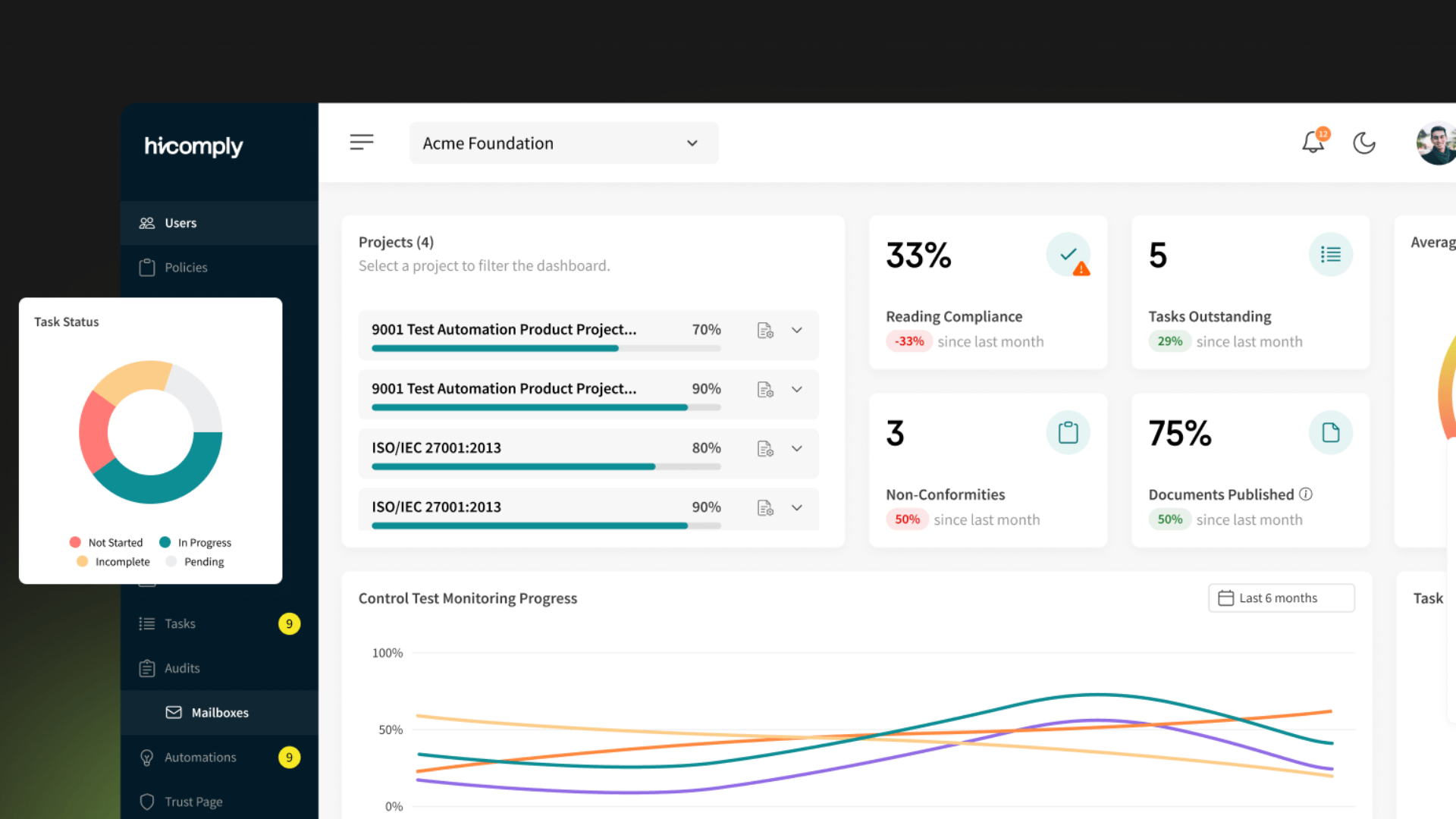
Hicomply's AI Evidence Discovery capability continuously identifies relevant evidence from connected systems and suggests how it maps to controls across different frameworks.
Instead of starting the evidence search from scratch, customers can review what's been surfaced, accept, amend or reject suggestions and maintain a clearer picture of their compliance position.
And because the AI learns from these decisions over time, its suggestions become increasingly relevant to each organisation.
There's an important distinction here: AI powers the searching and suggesting, but oversight and decision-making remain with people.
Smarter risk management, without removing accountability
Evidence collection is just one area where intelligent technology can help.
Risk management is another.
As organisations grow, new assets, systems, suppliers and processes introduce risks that need to be understood and managed.
Keeping risk registers accurate and aligned with these changes can be time-consuming.
At Hicomply, we support organisations with intelligent risk mapping to connect risks with the relevant assets, making it easier for customers to understand relationships and maintain visibility across their compliance programme.
But technology can't independently determine an organisation's risk appetite, understand every commercial consideration or take responsibility for accepting a risk.
Those decisions need context.
And that context comes from the people who understand the business, its priorities and its responsibilities.
Where should AI's role end?
There's a temptation to measure the success of automation by how much human involvement it removes.
But in compliance, that isn't necessarily the right measure.
AI can support increasingly complex activities, but there are important boundaries around where its role should end.
Consider three examples:
- Evidence: AI can identify and suggest evidence against a particular control. But the compliance team must determine whether it's relevant, current and sufficient to demonstrate that the control is effective.
- Risk management: Intelligent workflows can identify relationships between assets and risks. But assessing business impact, agreeing on treatment and accepting risk must remain the responsibility of the organisation.
- Policies: AI can help draft and structure documentation. But people need to validate that policies accurately reflect how the business operates, its obligations and the responsibilities of its employees.
In each case, technology can support the process, but it shouldn't independently determine the outcome.
And that's important because compliance isn't simply about completing tasks or producing documentation.
It's about demonstrating that the right controls are in place, that people understand their responsibilities and that the organisation is actively managing its risks.
AI can support your compliance programme. But accountability should always still sit with your business.
Better technology. Stronger human oversight.
For me, the most exciting thing about AI in compliance isn't the prospect of automating everything.
It's the opportunity to change how compliance teams spend their time.
Less manual searching. Less duplicated admin. Better visibility into what's happening across the business.
And more time to focus on reviewing risks, improving processes, supporting colleagues and making informed decisions.
That's the thinking behind how we're developing AI at Hicomply.
Because ultimately, good compliance depends on more than having the right information.
It depends on understanding what that information means, making informed decisions and taking responsibility for the outcomes.
AI should take on the legwork of compliance. Not the human judgement that governs it.